
Delivery time 48/72 hours (Pre-orders, holidays and islands excluded)
Enter your valid VAT to pay the taxable price

Oven Peels



The smell of freshly baked bread always attracts many customers to the shop, especially when it invades the streets early in the morning. But baking good bread also requires the right tools.
Small and compact or large and light? Choosing the right oven peel from the various models available is essential if you need to make professional use of it in a bakery or pastry shop.
OVEN PEEL MATERIALS
To meet the different needs of bakers, oven peels made of different materials can be found on the market. Among the most common are:
- Stainless steel. Stainless steel oven peels are the least sought-after type because they are quite heavy and may make the baker less agile when loading or unloading baked goods from the oven.
- Aluminium. Aluminium oven peels are the most popular in bakeries as they are light and easy to handle, as well as very resistant to corrosion and wear. In addition, aluminium peels are very easy to clean and allow the baker to always guarantee excellent hygienic safety for customers.
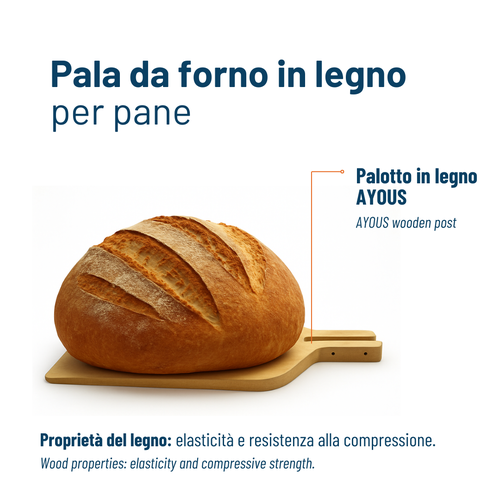
Wood. Traditional and classic, wooden oven peels are light, very durable and, in terms of flavour, give bread a more rustic touch. However, these peels require more care and attention during cleaning, as bacteria may accumulate or mould may form in the grain: it is important to keep wooden peels dry and clean after each use.

DESIGN IS IMPORTANT
In addition to the material, the shape of your oven peel can also make a difference, for example:
- Blade shape. Most peels have a flat blade, but you can find some on the market with a slightly inclined or curved blade to make it easier to slide bread and focaccia. A large blade is useful for lifting large loaves, while a smaller blade is useful for small rolls and brioches. Another important detail is the blade thickness, as it can provide more stability when loading and unloading bread from the oven.
- Dimensions. Oven peels come in different sizes: generally, larger peels are suitable for professional ovens, as they need to hold a larger amount of bread, while smaller peels can be used in home or small ovens.
- Handle. Finally, the shape of the handle is important to ensure a comfortable, stable and secure grip. Long handles are useful to keep the operator at a safe distance from the heat of the oven. In addition, materials such as wood and plastic do not conduct heat, limiting the risk of burns.
To make the oven peel work best for you, choose the material and design according to your baking and bread-making needs.
THE OVEN PEEL: SOME FUN FACTS
Bread peels, also known as baker's peels or oven peels, are often made of wood or metal and are used to load and unload bread from wood-fired and industrial ovens. Oven peels have a long history: the first loaves were baked on hot stones or directly on embers, which made it very difficult to handle the bread without getting burnt. To make their work easier and avoid unnecessary burns, the first bakers began to develop and perfect increasingly effective tools and techniques for baking bread.
The Egyptians were the first to use oven peels to bake loaves in small domestic ovens so that they would have large quantities of bread to serve at banquets. It was in the European Middle Ages, when the first dedicated baking ovens began to spread, that oven peels came into more common use. The first oven peels were made of wood and had a shape similar to the modern one: even today, wooden oven peels are still among the most widely purchased, but, compared to the first peels, they are longer and thicker so that larger loaves and larger quantities can be baked.

